A chest freezer packed with blanched sweet corn, green beans and summer berries is still running in December, after the market stalls have closed and the sun is lower and the days shorter than at any other time of year. For one ENERGY STAR chest freezer near Albany, NY, a 24V off-grid system needs about 775 W of solar panels to keep running through December. That works out to two 410 W panels wired in series. The figure includes the inverter’s idle draw and standard system losses, and it is sized from December sun rather than the yearly average.
The yearly average is the usual shortcut, and it is the reason winter systems come up short. Sized from the annual sun figure for the same spot, the array would come to about 270 W. In December, that array would cover roughly a third of what the freezer and inverter use each day.
The numbers on this page rest on these assumptions:
- One ENERGY STAR chest freezer, rated at 215 kWh a year.
- A Victron 24/800 inverter that stays on around the clock.
- December sun from NASA POWER’s 2001–2025 climatology at 42.65°N, 73.75°W, measured on a horizontal surface.
- The PVWatts default of 14% system losses, plus a 98% efficient MPPT charge controller.
- Panels kept clear of snow.
If a utility line already reaches the barn, the grid is the simpler way to run a freezer, and solar is one tool among several. This page is the hands-on follow-up to our case for solar power on winter farms. For the food side of the same freezer, see how the winter share is frozen and stored.
How much power does a chest freezer use per day?
An ENERGY STAR certified chest freezer uses about 0.59 kWh a day. ENERGY STAR gives the yearly figure as “about 215 kWh of electricity” at a running cost of about $30 a year (ENERGY STAR). Divided by 365, that is 589 Wh a day. An ENERGY STAR upright freezer uses about 395 kWh a year, nearly twice as much. Certified models of either type are “at least 10 percent more energy efficient than the minimum federal standard.”

ENERGY STAR explains the chest freezer’s advantage: “the door opens from the top and allows less cold air to escape.” The defrost type matters just as much: “Manual defrost freezers use half the energy of automatic defrost models” (ENERGY STAR). If a freezer is going to run on stored sunlight, start with a manual-defrost chest model. The cost is an afternoon with a scraper in early spring.
The same page recommends keeping the freezer at 0 °F. It also gives advice that matters for any barn freezer: “Unless you live in a mild climate, keep your freezer indoors, such as in the basement.” Extreme heat or cold puts stress on the compressor. The same advice turns out to apply to the battery.
If your freezer’s label shows a different yearly figure, divide it by 365 and use that number in the steps below.
Why the inverter adds about 44% to the load
A chest freezer runs on 120 V AC, so a 24V battery bank needs an inverter, and the inverter uses some energy of its own. This page uses the Victron Inverter VE.Direct 24/800 120V. It is rated for 800 W continuous, 90% maximum efficiency and 8 W at zero load (Victron inverter specifications). The inverter has to stay on day and night, because the compressor starts whenever the thermostat calls for it.
Eight watts sounds like very little. Over 24 hours it adds up to 192 Wh, about a third of the 589 Wh the freezer uses.
“` Freezer, at the plug 589 Wh/day ÷ 0.90 inverter efficiency = 654 Wh/day + 8 W idle × 24 h + 192 Wh/day Drawn from the battery = 846 Wh/day “`
That means the battery has to supply about 44% more than the freezer’s label says. We treat 846 Wh as a conservative figure, because the idle draw and the conversion loss partly overlap and this method counts some of the same loss twice. The 90% figure is the inverter’s maximum, and the spec sheet gives no efficiency figure for a load as small as one freezer.
The same sheet lists 2 W in ECO mode for the 24/800. ECO mode is a separate setting, and the sheet doesn’t say how it behaves with a compressor that cycles on its own. If ECO mode runs your freezer reliably, the daily load drops to about 702 Wh and the December array to about 643 W. We size with the 8 W figure until ECO mode has been tried on the freezer in question.
How many watts of solar for a chest freezer in December?
A chest freezer and inverter drawing 846 Wh a day need about 775 W of panels in December near Albany. NASA POWER puts December sun at that point at 1.2958 kWh/m²/day, the lowest of any month from November through March (NASA POWER climatology). One kWh per square meter equals one hour of full sun, so December gives about 1.30 peak sun hours a day.
PVWatts states its loss assumption: “The default value for system losses is 14%. Note that this value does not include the inverter performance” (PVWatts). That fits an off-grid build, because the inverter is already counted on the load side above. The SmartSolar charge controller has a peak efficiency of 98% (Victron MPPT specifications).
“` Daily load from the battery 846 Wh December sun 1.30 kWh/m²/day (1.30 peak sun hours) × 0.86 system losses (PVWatts 14% default) × 0.98 MPPT charge controller = 1.092 Wh a day for each watt of panel
846 Wh ÷ 1.092 = 775 W of panels “`
Two 410 W panels add up to 820 W, about 6% more than December needs.
Three conditions apply to that number. NASA’s figure is measured on a horizontal surface, and a panel tilted toward the low winter sun collects more, so the estimate errs on the safe side. The math assumes the panels are clear of snow. PVWatts version 8 added monthly loss inputs for snow and soiling, but this page doesn’t use them, so brush the panels off after a storm. And the number covers one freezer. A second freezer, or a heater for the battery, gets added to the daily load first.
For comparison, the annual average for the same point is 3.7378 kWh/m²/day. Sizing from that figure gives about 269 W. In December, 269 W makes about 294 Wh a day against a load of 846 Wh. If the freezer is emptied and unplugged by Thanksgiving, December no longer matters, and the November row in the table below is the one to use.
Array size month by month, November to March
December sets the size of the array, even though January is colder. NASA POWER’s January sun at this point is 1.61 kWh/m²/day, about 24% more than December’s, so the panels need less help after the solstice.
| Month | NASA POWER sun (kWh/m²/day) | Array needed for 846 Wh/day (W) | What 820 W makes (Wh/day) |
|---|---|---|---|
| November | 1.84 | 545 | 1,273 |
| December | 1.30 | 775 | 896 |
| January | 1.61 | 623 | 1,114 |
| February | 2.47 | 407 | 1,705 |
| March | 3.56 | 282 | 2,463 |
The surplus is thin in December, about 50 Wh a day, and an average month always includes gray weeks that draw the battery down. By March, the same two panels make nearly three times what the freezer and inverter use. The battery’s reserve for cloudy stretches is a separate decision, and this table doesn’t settle it.
January matters for the wiring. The coldest air of the year produces the highest panel voltage, and the voltage check below depends on that.
How many panels in series on a 24V system?
On a 24V battery with a 150 V Victron controller, two panels of this size in series is the right string. Victron’s installation guide sets cell counts for a 24V battery on a 150 V charger: a minimum of 72 cells in series and a maximum of 216, with 144 recommended for the best controller efficiency. It also says “The nominal PV voltage should be at least 5V higher than the battery voltage” (Victron installation guide).
The Qcells Q.PEAK DUO BLK ML-G10+ is a 132 half-cell panel (Qcells). A half-cell panel wires its cells as two halves in parallel, so 66 cells are in series. One panel falls short of the 72-cell minimum. Two panels put 132 cells in series, inside Victron’s range and close to the recommended 144.
By cell count alone, a third panel would also fit: 198 cells is under 216. The voltage check rules it out.
Do solar panels produce higher voltage in cold weather?
Yes, and on a 150 V controller, cold open-circuit voltage (Voc) is the check that limits how many panels can share a string. Victron’s manual says so: “At ambient temperatures below 25°C, the Voc will be higher.” It also sets the limit: “The maximum open circuit PV voltage can not exceed 150V” (Victron installation guide).
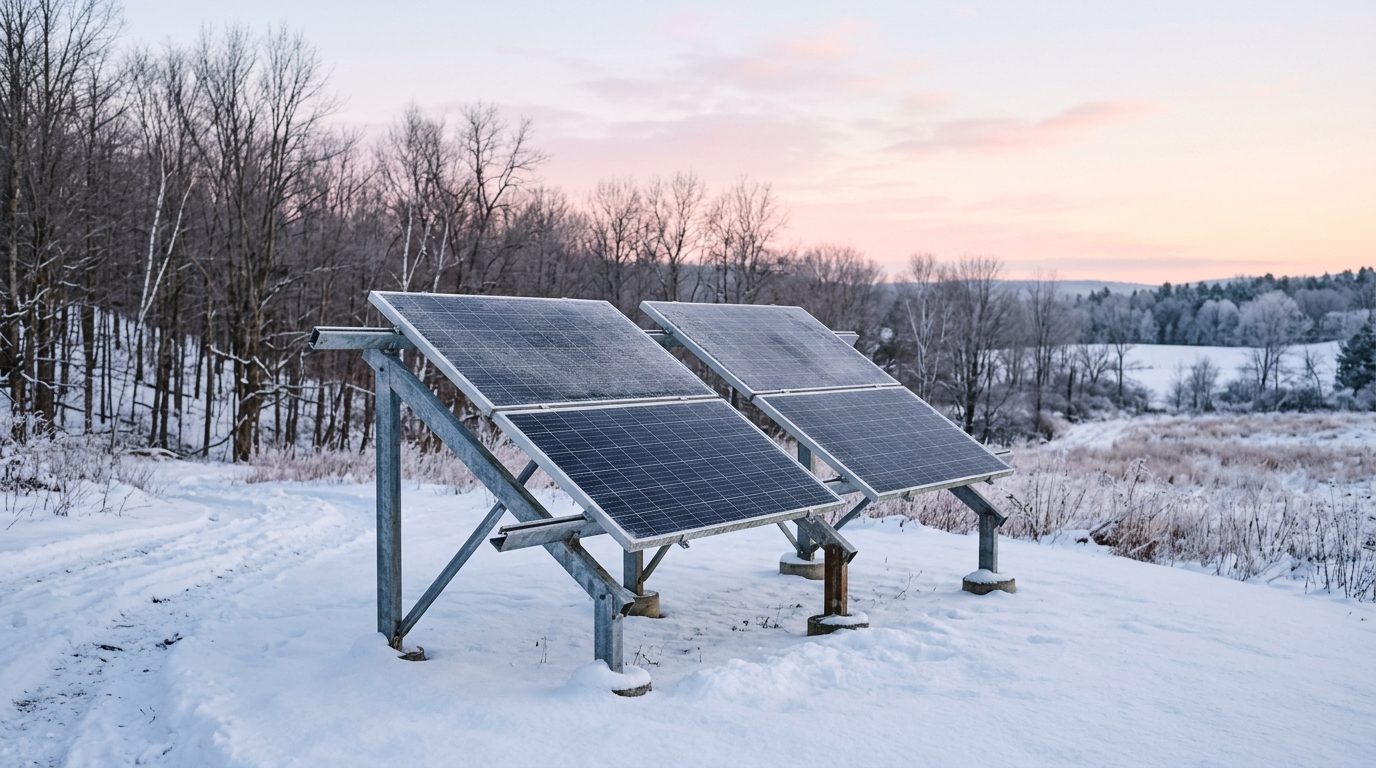
The Qcells series datasheet (Qcells datasheet) lists a Voc temperature coefficient of −0.27 %/K; confirm this against the current PDF before ordering. NASA POWER’s minimum air temperature for January at this point is −30.93 °C, the lowest of any month (NASA POWER climatology). That is 55.93 degrees below the 25 °C test temperature, which raises Voc by 15.1%.
| String of Qcells 410 W (Voc 45.37 V) | Voc at 25 °C (V) | Voc at −30.9 °C (V) | Within 150 V? |
|---|---|---|---|
| Two in series | 90.7 | 104.4 | Yes, 45.6 V to spare |
| Three in series | 136.1 | 156.7 | No, 6.7 V over |
At 136.1 V, three panels look like they have 14 V of headroom if you compare spec sheets on a summer day. Cold mornings take that headroom away. At December’s minimum of −21.59 °C, three panels still reach 153.2 V. The result doesn’t depend on the exact coefficient either: even at −0.19 %/K, three panels would pass 150 V at the January minimum.
The panel itself is rated down to −40 °F (Qcells), so the limit in this check comes from the controller. Victron’s MPPT sizing calculator runs the same check for other panels.
Which 24V panels fit this build?
Each 24V panel in the table below works as a pair on a 150 V controller. They differ in how close a pair comes to 775 W and how close three in series would come to 150 V. The models, voltages and prices are from one retailer’s 24V listing, seen November 21, 2026.
| Panel (as listed) | Cells | Power (W) | Voc (V) | Two in series (W) | Three in series, Voc at 25 °C (V) | Per string, 24V/150V | Price, Nov 21, 2026 |
|---|---|---|---|---|---|---|---|
| Jinko JKM385M-6RL3-B | 132 | 385 | 44.34 | 770 | 133.0 | 2 | $133.98 |
| JA Solar JAM54S31-405/MR | 108 | 405 | 37.23 | 810 | 111.7 | 2 | $146.81 |
| Qcells Q.PEAK DUO BLK ML-G10+ | 132 | 410 | 45.37 | 820 | 136.1 | 2 | $174 (was $326.07) |
| Trina TSM-415NE09RC.05 | 144 | 415 | 50.5 | 830 | 151.5 | 2 | $146.83, local pickup only |
| LONGi LR5-72HBD-540M | 144 | 540 | 49.5 | 1,080 | 148.5 | 2 | $179.01 |
| Solarever 450W | 96 | 450 | 35.03 | 900 | 105.1 | 2 | $177.12 |
Some notes on reading the table:
- A pair of Jinko 385 W panels comes to 770 W, 5 W short of December’s 775 W, which leaves no margin in the darkest month.
- The LONGi pair comes to 1,080 W, more than the 150/35 controller’s 1,000 W nominal at 24V. At 28.4 V that is about 38 A, above the controller’s 35 A limit, so some of the output would go unused. Three LONGi panels in series would already reach 148.5 V at 25 °C.
- Three Trina panels in series would be over 150 V before the weather turns cold at all.
- The JA Solar and Solarever panels have lower voltages. Whether three of them would pass the cold check depends on each datasheet’s coefficient. Three would exceed the controller’s 1,000 W anyway, at 1,215 W and 1,350 W.
- The Qcells pair is the one used in this page’s math, and it is the only one here that we ran the cold-voltage check on.
If you are pricing the two panels for this build, you can compare current models and per-watt prices of 24v solar panels. Look for a pair that clears 775 W without going past the controller’s 1,000 W, and check the datasheet’s Voc temperature coefficient before you add a third panel to any string.
Can a freezer and LiFePO4 battery stay in an unheated barn?
A LiFePO4 battery shouldn’t sit unheated in a northern barn through the winter. Victron’s lithium manual says “Charging the battery is only allowed in a temperature range of +5 °C to +50 °C” and “Discharge is only permitted in a temperature range of -20 °C to +50 °C” (Victron Lithium NG manual). Below 15 °C, charge current has to drop to 0.3C or less. At or below 0 °C, discharge is limited to 0.5C. At the temperature limit, the charger has to be switched off, for example through a BMS-controlled remote on/off.
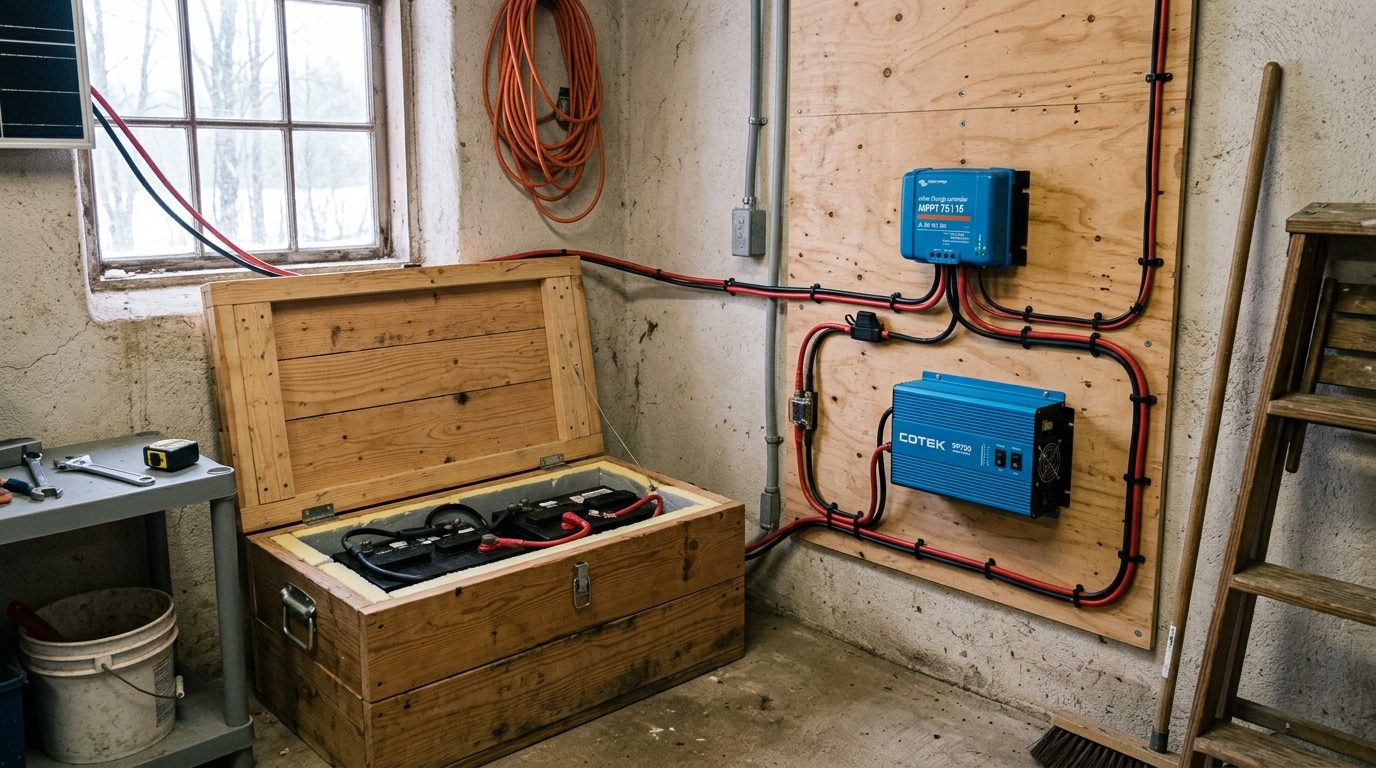
In practice, on a cold December day the panels make power but a battery below +5 °C (41 °F) can’t take it. Meanwhile the freezer keeps drawing about 33 Ah a day from a 25.6 V battery. NASA POWER’s January minimum of −30.9 °C outdoors is also below the battery’s −20 °C discharge limit. We don’t have a figure for how much warmer a closed barn stays, so treat that as unknown until you have measured it.
The 0.3C rule also affects battery size. Two 410 W panels can push about 29 A into the battery. To accept that current below 15 °C, the battery needs at least about 96 Ah. A smaller battery means setting a lower charge current limit on the controller.
There are two practical ways to keep the battery warm enough:
- An insulated, heated battery box. Add the heater’s draw to the 846 Wh daily load and run the panel math again.
- The battery, controller and inverter in a heated room, with a 120 V circuit run out to the freezer. ENERGY STAR’s advice to keep freezers indoors outside mild climates points the same way for the freezer.
For a grower with a barn or farm-stand freezer, like the participating farms, the warmest enclosed room on the property is where the battery should go. Set the charger for a 24V lithium bank at 28.4 V absorption and 27 V float.
Will a 150/35 controller handle two 410 W panels?
Yes, a Victron SmartSolar MPPT 150/35 handles two 410 W panels in series on a 24V battery. Its specifications list 1,000 W nominal PV at 24V, a 35 A maximum battery current, a 150 V maximum PV open-circuit voltage and 98% peak efficiency (Victron MPPT specifications). Two panels make 820 W, which is about 28.9 A at the 28.4 V absorption voltage. That stays under 35 A and leaves 180 W of the controller’s nominal rating unused.
The controller’s operating range is −30 °C to +60 °C, with full rated output up to 40 °C. January’s minimum at this point is −30.9 °C, just below that range, which is one more reason to mount the controller indoors next to the battery.
Questions about freezers and solar panels
Can a 100 W solar panel run a chest freezer?
No. In December near Albany, a 100 W panel makes about 109 Wh a day after losses, around 13% of the 846 Wh a freezer and inverter use. Even in March it makes about 300 Wh, roughly a third of the load.
What size inverter do I need for a chest freezer?
For one chest freezer on 24V, this page uses the Victron 24/800, rated for 800 W continuous and 1,200 W for 15 seconds. The smaller 24/500 is rated for 460 W continuous and 750 W for 3 seconds at the same 8 W idle draw, and with it the December array works out to about 789 W. ENERGY STAR doesn’t list starting current, so check your freezer’s nameplate against the inverter’s peak rating. A bigger inverter has a cost: the 24/1200 idles at 11 W, which raises the December array to about 834 W, more than two 410 W panels provide (Victron inverter specifications).
Does a chest freezer use more power in winter?
ENERGY STAR doesn’t publish a winter figure. It advises keeping a freezer indoors outside mild climates because extreme heat or cold puts stress on the compressor (ENERGY STAR). This page spreads the yearly rating evenly across the days of the year.
What to cook from the freezer in February
In the lean weeks before spring, take out a bag of that summer corn. Soften a diced onion in butter, add potatoes from the root cellar and enough water to cover, and simmer until a knife slips through them. Then add the corn and milk, and keep the pot just short of a boil until the kernels are hot. It tastes of August.
Sources
- ENERGY STAR, Freezers, seen November 21, 2026.
- NASA POWER, Climatology API, ALLSKY_SFC_SW_DWN and T2M_MIN at 42.65°N, 73.75°W, 2001–2025 climatology, API v2.10.2, retrieved November 21, 2026.
- PVWatts Calculator (NLR, formerly NREL), About and version history, seen November 21, 2026.
- Victron Energy, SmartSolar MPPT 150/35 & 150/45 manual: Technical specifications, seen November 21, 2026.
- Victron Energy, SmartSolar MPPT 150/35 & 150/45 manual: Installation, seen November 21, 2026.
- Victron Energy, Inverter VE.Direct 120V (HW15): Technical specifications, seen November 21, 2026.
- Victron Energy, Lithium NG battery 25.6 V manual: Operation, seen November 21, 2026.
- Qcells North America, Q.PEAK DUO BLK ML-G10+, seen November 21, 2026.
- Qcells, Q.PEAK DUO BLK ML-G10+ series datasheet, seen November 21, 2026.
- Panel models, Voc and prices: retailer listing of 24V solar panels linked above, prices seen November 21, 2026.
- Calculations on this page are our own arithmetic from the figures above.
Updated: November 21, 2026